That $200 celebrity tequila sitting behind your bar? It might come from the exact same distillery as the $40 craft bottle next to it. Same production line. Same agave source. Different label. Different story. Different price tag.
Welcome to the reality of the tequila industry, where marketing budgets often outweigh production transparency.
I’m Marcus Guiliano, founder of DOC Agave and a tequila educator who’s visited over 350 distilleries across Mexico. I’ve walked production floors where five different “premium” brands are bottled side by side. I’ve tasted tequilas that cost ten times more than their neighbors but share the exact same liquid inside.
The key to understanding this industry? NOM numbers on tequila labels—a simple code that unlocks the truth about where your tequila actually comes from.
By the end of this guide, you’ll know how to read tequila labels like a customs agent. You’ll understand which brands share distilleries, which production methods matter, and how to verify authenticity before you commit to a purchase order.
For distributors, buyers, and industry professionals, this is competitive intelligence that directly impacts your sourcing decisions, pricing strategy, and portfolio credibility.
What is a NOM Number on Tequila?
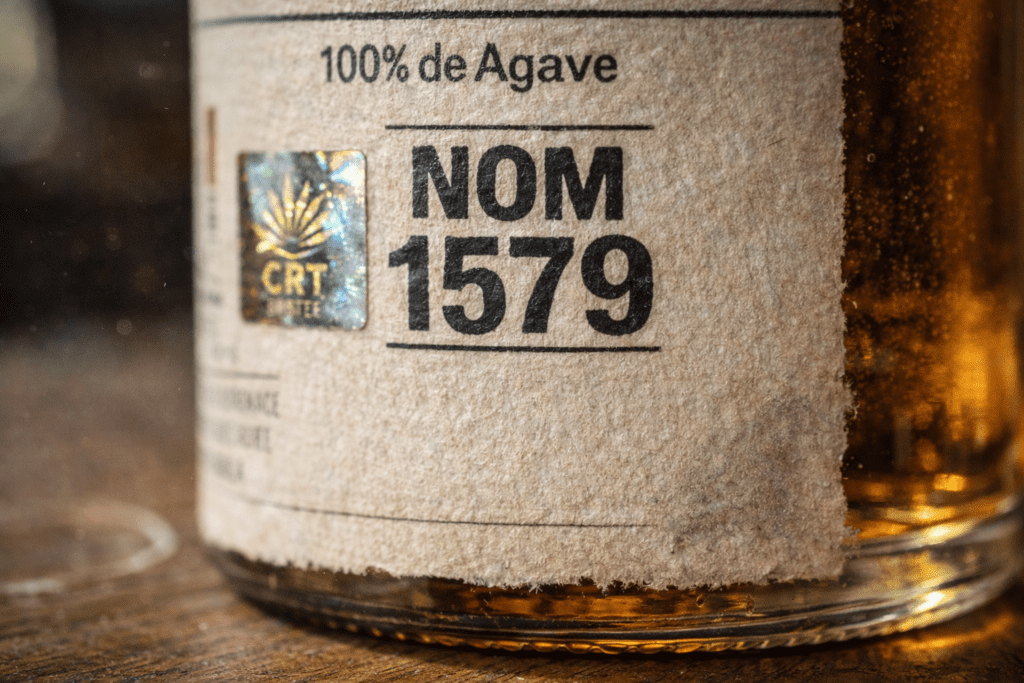
Every legal bottle of tequila sold anywhere in the world must display a four-digit code on its label. This code is the NOM number—short for Norma Oficial Mexicana.
It’s not a brand identifier. It’s a distillery registration number.
The NOM tells you exactly where the tequila was produced. It tells you the physical location where the agave was cooked, fermented, distilled, and bottled.
Think of it like a factory serial number. One distillery can produce dozens—sometimes hundreds—of different tequila brands under a single NOM.
NOM numbers are issued and regulated by the CRT (Consejo Regulador del Tequila), the official governing body that enforces Mexico’s tequila denomination of origin laws.
Under Mexican law, tequila can only be produced in five designated states: Jalisco, Guanajuato, Michoacán, Nayarit, and Tamaulipas.
For distributors and industry professionals, the NOM number is your most powerful tool for supply chain transparency. It answers critical questions:
- Which distillery actually made this tequila?
- Do multiple brands share the same production facility?
- What production methods does this distillery use?
- Is this a contract-produced celebrity brand or an estate distillery?
Without the NOM, you’re buying a story. With the NOM, you’re buying verified sourcing intelligence.
The Shared Distillery Reality
Here’s the truth: the industry runs on contract production.
There are about 140 registered tequila distilleries in Mexico. They produce over 3,500 different tequila brands.
Most distilleries aren’t making one signature tequila. They’re running multiple production lines for multiple clients at the same time.
Contract distilling is a legitimate business model. The problem is the lack of transparency.
Launching a tequila brand is expensive. Building a distillery from scratch needs millions in capital, regulatory approval, agave contracts, and years of expertise.
Most celebrity-backed brands and startup tequila companies partner with established distilleries that have excess capacity.
But here’s what buyers need to understand: the NOM number tequila code reveals this relationship right away.
When you look up a high-volume contract distillery, you might find 20, 30, even 50 brands all sharing the same NOM. Some are priced at $40. Others at $150. A few celebrity bottles push $200 or more.
Same distillery. Same agave source. Often the same base recipe.
Take NOM 1438, operated by Tequila Cazadores’ parent company. This facility produces Cazadores and several other brands.
When you look up this NOM in Tequila Matchmaker, you see the full list of brands bottled there.
For buyers, this is critical intelligence. If you’re paying a premium for a “boutique” brand, you deserve to know if it’s produced at a high-volume contract facility.
I’ve visited these high-volume contract facilities. I’ve watched them switch labels mid-bottling run. Same liquid, different brand, different price point.
NOM numbers give you that leverage. Your customers trust you to vet quality.
How to Read a Tequila Label
A tequila label isn’t just marketing. It’s a legal document that reveals everything you need to verify authenticity and quality.
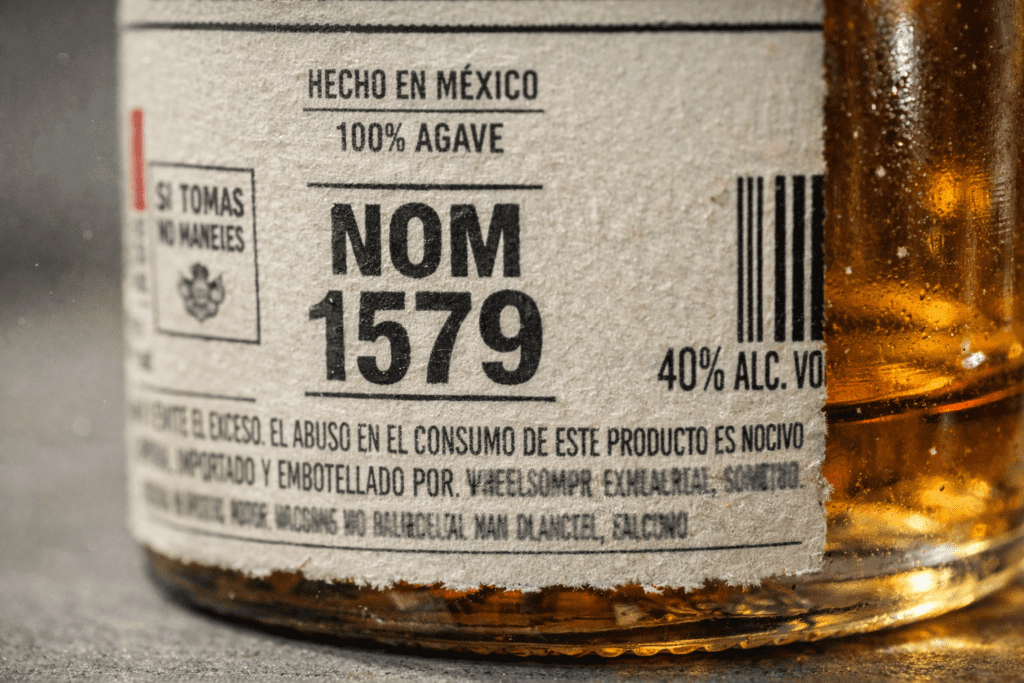
The NOM number is almost always printed on the back label, near the bottom. It’s a four-digit code, typically formatted as “NOM 1234” or “NOM-1234-X.”
Some premium brands display it on the front label. Others bury it in small print on the back. But it must be there.
If you can’t find a NOM number, walk away.
Look for the exact phrase: “100% de Agave” or “100% Agave Azul.” This is the single most important quality indicator on the label.
If the label says “Tequila” without the 100% agave designation, it’s a mixto—a blend of agave and non-agave sugars. Mixtos can legally contain as little as 51% agave.
I’ve seen distributors get burned by this. They assume any bottle labeled “Premium Tequila” is 100% agave. It’s not.
For most distributors and high-end buyers, mixtos aren’t worth your time. They’re cheaper to produce, harsher to drink, and lower in quality.
100% agave is the baseline.
The CRT stamp or hologram is proof that the tequila was inspected and approved by Mexico’s regulatory council.
This mark confirms denomination of origin compliance.
Mexican law needs the label to show where the tequila was produced. This is usually listed as a state or a specific region.
Most tequila comes from Jalisco, split between two main areas:
- Los Altos (Highlands): Known for fruity, floral, sweeter profiles
- Tequila Valley (Lowlands): Known for earthy, mineral, peppery profiles
The label must state the tequila’s aging classification:
- Blanco (Silver): Unaged or aged less than 2 months
- Reposado: Aged 2 months to 1 year in oak barrels
- Añejo: Aged 1 to 3 years in oak barrels
- Extra Añejo: Aged 3+ years in oak barrels
Mexican regulations do not need labels to show additives, production methods, agave source, or barrel types.
This is why the NOM number is so critical. It’s your gateway to researching production methods.
How to Look Up a NOM Number
Reading the label is step one. Researching the NOM is step two.
Tequila Matchmaker is the most comprehensive tequila database available. It’s free to use and constantly updated.
Go to TequilaMatchmaker.com or download the mobile app. Use the search bar to enter the NOM number. Review the distillery profile and full brand list.
This is where you discover if your “boutique” brand shares a facility with 30 others.
The CRT maintains an official registry of all certified tequila producers at CRT.org.mx.
When you research a NOM number, you unlock supply chain transparency:
You’ll see the legal name of the facility and its exact location. This tells you if the tequila comes from the Highlands or Lowlands, which affects flavor profile.
You’ll see every brand produced at that distillery.
Tequila Matchmaker lists whether the distillery uses traditional methods or industrial shortcuts. This directly impacts flavor and quality.
Let’s say you’re evaluating a new tequila brand. The label shows NOM 1579.
You look it up. You discover NOM 1579 is El Pandillo, one of the highest-ranked distilleries in Mexico. They use stone ovens exclusively. They produce a small portfolio of ultra-premium brands.
Now compare that to NOM 1104. It’s a massive contract facility producing 50+ brands, using autoclaves and diffusers.
I’ve personally visited both distilleries. The difference isn’t just on paper—you can taste it.
That’s the power of NOM research. It turns a four-digit code into a strategic decision-making tool.
What NOM Research Reveals
Not all distilleries are created equal. Some prioritize tradition and craftsmanship. Others optimize for volume and cost efficiency.
High-volume contract facilities have the capacity to produce millions of liters per year for multiple brands.
They’re efficient, consistent, and scalable. If you need reliable supply, a high-volume distillery can deliver.
Quality can be inconsistent across brands. When a distillery runs 20 different client recipes, attention to detail suffers.
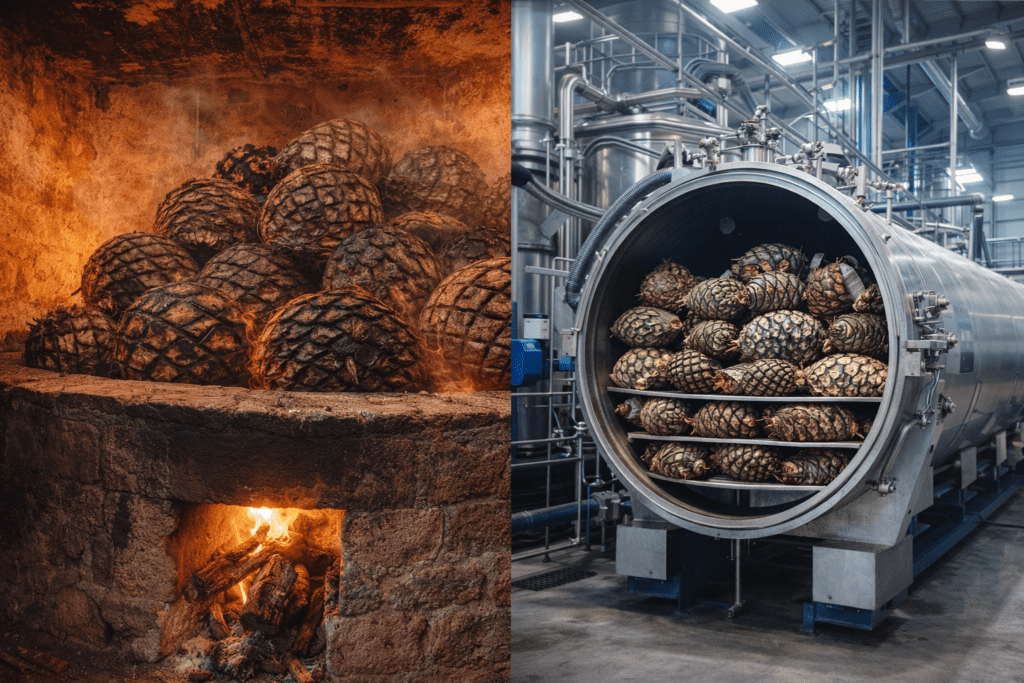
Autoclaves are high-pressure steam ovens that cook agave in 8-12 hours instead of the traditional 24-72 hours. They’re efficient but strip away flavor complexity.
Diffusers are worse. A diffuser shreds raw agave and chemically extracts sugars using hot water and sulfuric acid—before cooking. It’s fast and cheap but produces a flat spirit.
I’ve tasted diffuser tequilas that cost $100. They taste like vodka with agave flavoring. No depth. No character.
Stone or brick ovens cook agave slowly, letting natural caramelization happen. This is how tequila was made for centuries. It takes longer, costs more, and produces a richer spirit.
Tahona mills use a massive stone wheel to crush cooked agave. Most distilleries use mechanical shredders for speed. Tahonas are slower but keep agave fibers that add texture and flavor.
Mexican law lets tequila producers add up to 1% additives without showing them. That includes glycerin, caramel coloring, oak extract, and sweeteners.
Most consumers have no idea this is legal. Most distributors don’t either.
Tequila Matchmaker maintains an additive-free certification list. When you look up a NOM, you can see if the distillery has committed to transparency.
For distributors building premium portfolios, additive-free should be a baseline requirement.
Celebrity Tequila and the NOM
Celebrity-backed tequila brands are everywhere. Actors, musicians, athletes—everyone wants a piece of the tequila market.
Most brands follow the same playbook: partner with an established distillery, customize a recipe, design premium packaging, and leverage celebrity influence.
There’s nothing inherently wrong with this model. But buyers need to understand what they’re actually purchasing.
When you look up the NOM, you see which distillery is making the liquid. Often, you’ll find multiple celebrity brands sharing the same facility.
If a celebrity brand charges $150-200 per bottle, you’d expect exclusive production. But when you look up the NOM and find 15 other brands—some priced at $40-60—you have to question the premium.
Are you paying for production quality? Or marketing?
You’re evaluating a celebrity-backed tequila priced at $180. Premium packaging. Compelling brand story.
You look up the NOM. It’s produced at a facility with 25+ brands. Some retail for $40. Others for $60.
Same distillery. Same agave region. Autoclave-based production.
Now you know: the premium price is for the name on the bottle, not the liquid inside.
Before committing to any celebrity or premium tequila brand, run this checklist:
- Look up the NOM number—identify the distillery
- Check how many brands share that NOM
- Research production methods—stone oven or autoclave?
- Compare pricing—what do other brands from the same NOM cost?
- Verify additive-free status
- Assess brand transparency
If the brand passes all six checks, it might be worth the premium. If it fails three or more, you’re paying for marketing, not quality.
Beyond the Label
The NOM is your primary research tool. But it’s not the only quality signal.
High-quality tequila often comes in heavy, thick glass bottles. But don’t be fooled. Heavy glass doesn’t guarantee quality liquid.
Premium tequila brands often include batch numbers or lot codes. This signals small-batch production and traceability.
Tequila competitions are everywhere. Some are legitimate. Many are pay-to-play schemes.
Take awards with skepticism. Better yet, use NOM research and expert reviews from trusted sources instead.
Does the brand openly discuss its distillery partnership? Does it name the master distiller? Does it explain production methods?
Transparency is a confidence signal.
Price doesn’t always reflect quality. Some $200 bottles are worth every penny. Others are $40 tequila in $160 packaging.
Use NOM research to evaluate if the price matches the production reality.
Don’t pay for marketing. Pay for quality liquid.
The NOM Is Your Transparency Tool
The tequila industry runs on stories. Celebrity endorsements. Premium packaging. Lifestyle branding.
But behind every story is a four-digit code that reveals the truth.
The NOM number on tequila labels is your gateway to supply chain transparency. It tells you where the tequila was made. It shows you which brands share distilleries.
For distributors, buyers, and industry professionals, NOM research isn’t optional. It’s due diligence.
Before you commit to a purchase order, look up the NOM. Research the distillery. Compare brands. Check production methods. Verify additive-free status.
Don’t pay for celebrity endorsements and premium packaging when you’re getting industrial contract production. Don’t overlook legitimate craft brands because they don’t have a famous face on the bottle.
The NOM gives you x-ray vision. Use it.
This guide gives you the foundation. Want to go deeper? DOC Agave’s Tequila Masterclass Certification is your next step.
I’ve spent decades visiting distilleries, tasting thousands of tequilas, and teaching industry professionals how to separate craft from marketing.
You’ll learn how to evaluate tequila beyond the label. How to identify additives by taste. How to use tools like Tequila Matchmaker. And how to build a portfolio your customers will trust.
Because at the end of the day, understanding NOM numbers isn’t just about vetting brands. It’s about respecting the craft, honoring the distillers who do it right, and giving your customers the transparency they deserve.
Start with the NOM. End with the truth.