
How to tell if tequila is real starts with facts you can check on the bottle. Sweetness, price, and fancy packaging are not proof. Real tequila must meet Mexico’s rules for origin, ingredients, production, certification, and labels.
That distinction matters because fake tequila and low quality tequila are different problems. Fake tequila raises an authenticity question. Low quality tequila raises a quality question. A legal tequila can still use industrial methods, heavy marketing, or a style you do not enjoy.
Key Takeaway: Verify authenticity before judging quality. Start with the label, category, producer, NOM, and package condition. Then look at how the producer explains the process and what you notice in the glass. Taste, color, price, celebrity ownership, packaging, and industrial methods do not prove that a tequila is fake.
How can I tell if tequila is real or fake?
Check the label, category, producer, NOM details, and package condition first. If those details line up, you have a clear research trail. If they do not, verify the bottle before judging it by taste.
How to spot fake tequila: read the label first
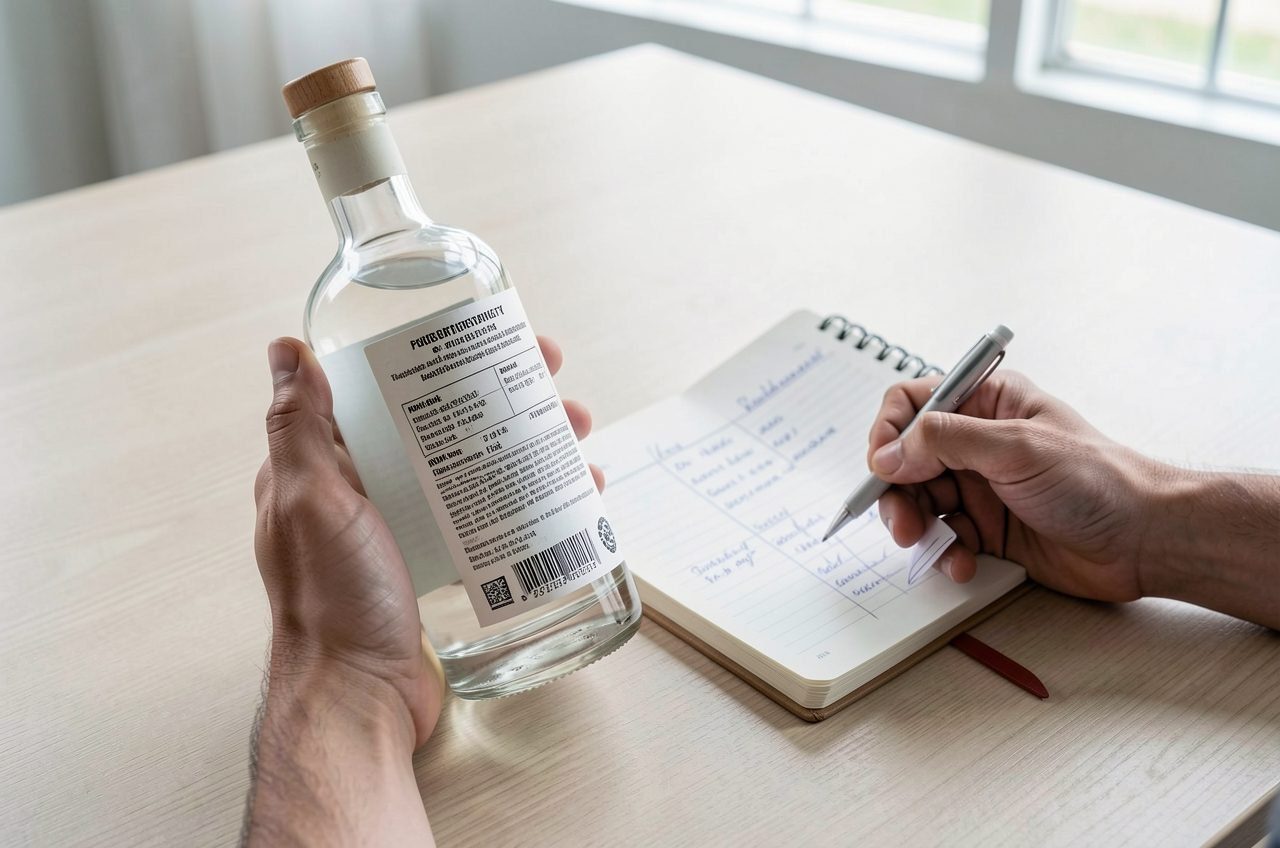
If you want to know how to spot fake tequila, start with the required label details. Mexico’s Tequila Regulatory Council lists the core information to check. Look for Tequila, the class and category, producer, NOM, alcohol percentage, net content, and lot. The CRT also tells buyers to check that the label is complete and the closure is intact. The CRT’s tequila guide explains the current framework.
Do not use one sip as your first test. Missing information, an altered closure, or details that do not match should make you stop and verify the bottle.
Real tequila vs fake: use the NOM as a research trail
A tequila NOM number points you to the authorized producer or production site. The brand on the front and the company that makes the spirit may be different.
A NOM is not a quality grade. It does not tell you that every brand from one producer tastes the same. Use it to continue your research. My guide to reading tequila labels and NOM numbers explains that step in more detail.
Know the two tequila categories
Mexico recognizes Tequila 100% Agave and the broader Tequila category. Tequila 100% Agave gets its sugars only from blue Weber agave. The broader category must still get at least 51% of its sugars from blue Weber agave. Other permitted sugars can make up the rest.
So a bottle that does not say 100% Agave is not automatically fake. It belongs to a different legal category. The DOC Agave guide to Blue Weber agave adds useful context about the raw material.
Mexico’s official registry lists NOM-006-SCFI-2012 as in force. I use that standard for the legal claims in this guide, not marketing slogans.
Check the package
Look at the closure and label as a whole. Missing information, signs that someone opened the bottle, or details that do not match deserve a closer check.
Do not confuse fancy packaging with proof of quality. A plain bottle can hold excellent tequila. An expensive bottle can still tell you little about how the spirit was made.
What are the red flags of low-quality tequila?
Low quality tequila is a separate issue from fake tequila. The strongest warning sign is often a weak or vague production story. If a brand talks mostly about lifestyle, luxury, celebrity ownership, or “smoothness,” look for the facts behind the story.
Taste can raise questions, but it cannot prove fraud. Strong sweetness, vanilla, dark color, or a very neutral profile may make you ask how the producer made and finished the spirit.
Look for a clear production story
I want a producer to explain where the agave comes from, who makes the spirit, and how the main steps work. Useful details include cooking, sugar extraction, fermentation, distillation, aging, and finishing.
A diffuser or another industrial method does not make a tequila fake. It tells you about one production choice. My guide to diffuser tequila vs traditional tequila explains those differences without treating one method as proof of fraud.
Use taste as a clue, not proof
“Smooth” tells you very little by itself. One tequila may be easy to drink and still show clear agave character. Another may taste sweeter or show more vanilla. Style and quality are not the same thing.
The same rule applies to color and texture. Darker does not always mean older or better. A thicker texture does not prove that the producer added something. If something surprises you, ask what could explain it and check the producer’s information.
Ignore shortcuts like price and celebrity ownership
Price can reflect agave, labor, aging, supply, packaging, or marketing. Celebrity ownership can sit on top of strong production or ordinary contract production. Neither one proves that the tequila is real or well made.
Use a two-stage verification system
I use two stages because they keep the questions separate. Stage 1 asks whether the bottle can legally be tequila. Stage 2 asks what the evidence says about quality and transparency.
| Signal | What it may tell you | What it does not prove | What to check next |
|---|---|---|---|
| 100% Agave statement | Legal sugar-source category | High quality or traditional production | Producer, NOM, process details |
| NOM / producer information | Where the tequila was made | That every brand from that producer is equal | Producer and process details |
| Missing label detail or damaged closure | An authenticity concern | Why the problem happened | Official label rules and producer information |
| Sweet, dark, or vanilla-heavy profile | A reason to ask about style | Fraud or one exact method | Producer explanation |
| Industrial method, high price, or celebrity name | A production or marketing choice | Authenticity or quality | Label, NOM, producer, process |
A clue can be useful without proving the case. That is the point of the system.
A practical tequila check
When I check a bottle, I move in this order:
- Read the label. Confirm that it says tequila and note the class and category.
- Find the NOM and producer. Use them to identify who made the spirit and where.
- Check the closure and label details. Verify anything that looks wrong or incomplete.
- Read the production story. Look for clear details about agave, cooking, fermentation, distillation, aging, and finishing.
- Taste last. Let flavor, color, and texture create questions instead of accusations.
If the first three steps do not add up, you have an authenticity question. If they do add up but the production story stays vague, you are judging quality and transparency.
Why I separate authenticity from quality
In my work with agave producers across Jalisco, Oaxaca, and other parts of Mexico, I have seen many ways to make a finished spirit. That is why I do not use shortcuts such as “traditional equals real” or “industrial equals fake.”
A label can show category information. A NOM can point to the producer. A production explanation can describe the process. A tasting note can describe your experience. Each clue has a limit.
That whole-picture approach is why I built DOC Agave’s educational framework. It helps hospitality professionals and curious readers ask better questions without turning every difference in flavor or process into a fraud claim.
Verification beats suspicion
The best answer to how to tell if tequila is real is to verify the bottle before you judge the flavor. Check the label, category, producer, NOM, origin, and package condition. Then use production details and tasting notes to judge quality.
That takes more work than judging a bottle by sweetness, color, price, or celebrity marketing. It also gives you a much better answer.
Want to go deeper into how tequila is made, labeled, tasted, and evaluated? Continue with the DOC Agave Tequila Masterclass.