
Most people think tequila quality comes from aging. They look at extra añejo bottles and assume time in wood creates value.
But here’s the truth: if the agave wasn’t right, no barrel will save it.
I’m Marcus Guiliano, founder of DOC Agave and a tequila educator. I’ve been all over Oaxaca, Jalisco, and other parts of Mexico visiting agave producers. I’ve walked agave fields in the Highlands and Lowlands of Jalisco. I’ve watched jimadores harvest plants that took nearly a decade to mature.
One lesson became clear: blue weber agave is where everything starts.
It’s the foundation beneath the NOM numbers that reveal supply chain transparency. It’s the raw material that terroir shapes into distinct flavor profiles. It’s the sugar source that barrel aging can enhance or bury.
This guide explains what blue weber agave actually is. You’ll learn how the plant matures over seven to ten years. You’ll discover why it’s the only agave variety legally approved for tequila production. You’ll see how to identify quality tequila by understanding the plant behind it.
By the end, you’ll know why this single cultivar defines the whole industry. And why respecting the plant means respecting the Mexican families who’ve cultivated it for generations.
What is Blue Weber Agave? (The Botanical & Legal Foundation)
Let’s start with what blue weber agave actually is—botanically, legally, and practically.
The scientific name is Agave tequilana Weber var. azul. That’s the full botanical designation recognized worldwide.
Agave tequilana is the species. Weber honors Frédéric Albert Constantin Weber, the 19th-century botanist who classified it. Azul (Spanish for “blue”) describes the distinctive blue-gray color of the leaves.
Most people just call it blue agave or agave azul. But the full name matters when you’re verifying authenticity.
This plant is a succulent, not a cactus. It belongs to the Asparagaceae family. The confusion happens because agave grows in arid climates and has thick, spiky leaves. But botanically, it’s closer to asparagus than cacti.
Here’s why that botanical precision matters: Mexican law is strict about what qualifies as tequila.
According to the Consejo Regulador del Tequila (CRT)—Mexico’s official tequila regulatory body—tequila can only be made from Agave tequilana Weber var. azul. No other agave species is allowed.
There are over 200 species of agave in Mexico. Many are used for mezcal. But for tequila? Only one.
This legal designation protects both the spirit’s identity and the regions where it’s produced. Tequila has denomination of origin status, just like Champagne or Scotch. It can only be made in five Mexican states: Jalisco, Guanajuato, Michoacán, Nayarit, and Tamaulipas.
If you see a bottle labeled “100% agave” without specifying blue weber, be skeptical. The CRT requires proper labeling. Legitimate producers state “100% Agave Azul” or “100% Blue Weber Agave” clearly.
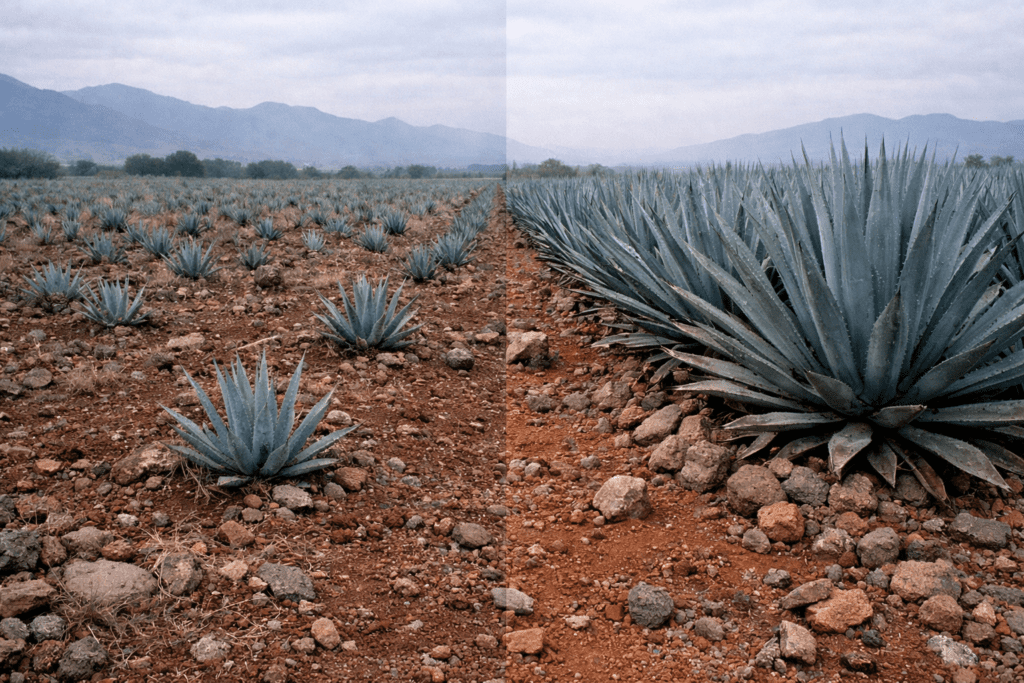
Visually, blue weber agave is striking. The plant forms a rosette shape with thick, pointed leaves. Mature plants can reach six to eight feet tall and ten to twelve feet across.
The leaves are blue-gray with a waxy coating that protects against water loss. Sharp spines line the leaf edges and tip. This evolved as defense against animals in the harsh Jalisco climate.
At the center is the piña—the heart of the plant. This is the part that gets harvested for tequila production. A mature piña can weigh anywhere from 40 to 200+ pounds, depending on growing conditions and harvest timing.
The name “piña” comes from its resemblance to a giant pineapple once the leaves are removed. It’s dense, fibrous, and packed with the sugars that ferment into alcohol.
Understanding what blue weber agave is—botanically and legally—sets the foundation. Because this single plant, grown in specific regions under Mexican law, defines the entire tequila industry.
Next, let’s talk about how long it takes this plant to become ready for harvest. Because that timeline is where most people—even industry professionals—get it wrong.
The 7-10 Year Journey: How Long Does Agave Take to Grow?
Here’s a question most bartenders and distributors can’t answer correctly: how long does agave take to grow before harvest?
Most guess two to three years. Maybe four. The truth? Seven to ten years for proper maturity.
That’s not marketing. That’s biology.
Blue weber agave is not corn. It’s not sugarcane. It doesn’t grow fast. The plant needs time to develop the sugar density and chemical complexity that create quality tequila.
When I walk agave fields with producers in Jalisco, I see plants at different life stages. Young plants that were just transplanted. Mid-stage plants building mass. Mature plants ready for harvest. The difference is visible—and it matters.
Let me break down what actually happens over those years.
Years 1-3: Establishment and Early Growth
The journey starts with propagation. Most blue weber agave is cloned from parent plants using hijuelos—small offshoots called “pups” that grow at the base.
Farmers transplant these pups into fields. The young plant focuses on root development and establishing itself in the soil. Leaves are small and growth is slow.
During this phase, the plant is vulnerable. It needs consistent water but not too much. It faces threats from pests and disease. Many producers lose 10-20% of young plants in the first two years.
The piña—the heart of the plant—is developing but small. Maybe 5-10 pounds. Not enough sugar for viable production.
Years 4-6: Sugar Accumulation and Leaf Development
This is where the plant starts showing serious growth. The rosette expands. Leaves multiply and reach full size. The plant can now span eight to ten feet across.
Photosynthesis is happening at scale. The plant converts sunlight into sugars and stores them in the piña. Weight increases from 10 pounds to 60-80 pounds.
But here’s the critical point: the sugars aren’t just accumulating. They’re also developing chemical complexity. Aromatic compounds form. Flavor precursors build. This complexity can’t be rushed.
This is also when terroir starts shaping character. Highlands agave absorbs iron-rich red volcanic soil minerals. Lowlands agave takes on the darker clay earth characteristics.
Soil composition, temperature swings, rainfall patterns—all of this gets encoded into the plant’s chemistry during years four through six.
Years 7-10: Peak Maturity and Optimal Sugar Content
By year seven, the plant reaches harvestable maturity. The piña weighs 80-150+ pounds. Sugar content hits optimal levels—typically 24-28% total soluble solids (TSS).
This is the sweet spot. The plant has maximum sugar density without being over-mature. The flavor precursors are fully developed. The agave is ready.
Some producers let plants go to year eight, nine, or even ten for specific flavor profiles. Older plants can develop more complex, nuanced character. But they also face risks—disease, over-maturity, or premature flowering.
When an agave plant reaches about seven years old, it tries to reproduce. It sends up a quiote—a tall flowering stalk that can reach 20+ feet. If the jimador doesn’t cut this stalk, the plant diverts all its stored sugars into reproduction. The piña becomes worthless for tequila.
Experienced jimadores watch for this. They cut the quiote before it fully develops, forcing the plant to redirect sugars back into the piña. This is called “castrating” the plant.
Why Patience Matters (And Why Many Producers Skip It)
Here’s the uncomfortable truth: many tequila producers harvest agave at four to five years.
Why? Economics. Agave farming is expensive. Land, labor, water, pest management—it all adds up. The longer you wait, the more it costs.
A four-year-old plant might weigh 50-60 pounds. It’s technically harvestable. You can extract some sugar. You can make tequila.
But it won’t be good tequila.
Young agave has low sugar content—maybe 18-20% TSS instead of 26-28%. That means you need more agave to produce the same amount of alcohol. The flavor is thin, vegetal, and one-dimensional.
Producers who harvest young try to compensate with processing shortcuts. They use diffusers to chemically extract every bit of sugar. They add oak extract and glycerin to create fake complexity. They age heavily to mask the lack of agave character.
This is why understanding how long agave takes to grow matters. If a brand can’t tell you the average maturity of their agave, that’s a red flag.
Craft producers are transparent. They’ll tell you: “We harvest at seven to eight years.” That’s confidence in the raw material.
Industrial producers dodge the question. They talk about barrels, celebrity partnerships, or awards instead. That’s because they’re hiding young, low-quality agave.
The Sugar Content Science
Sugar content isn’t just about alcohol yield. It’s about flavor.
When you cook agave, heat breaks down complex carbohydrates (inulins) into simple sugars. Those sugars ferment into alcohol. But the process also creates aromatic compounds—esters, phenols, and terpenes—that define tequila’s flavor.
Higher sugar content means richer, more complex aromatics. Lower sugar content means flat, one-note flavor.
Producers measure sugar content using a refractometer. They take a sample from the piña and measure TSS (total soluble solids) as a percentage or in degrees Brix.
Typical ranges:
- 18-21% TSS: Young agave, poor quality
- 22-25% TSS: Fine but not ideal
- 26-28% TSS: Optimal maturity for premium tequila
- 29%+ TSS: Excellent but rare, requires perfect growing conditions
When I visit distilleries, I ask about average TSS. Good producers know their numbers. Poor producers change the subject.
The seven-to-ten-year timeline isn’t arbitrary. It’s what the plant needs to reach peak sugar density and flavor complexity.
Rushing that timeline is like harvesting grapes for wine at half ripeness. You can technically make alcohol. But you can’t make quality alcohol.
Next, let’s dig into what’s actually happening inside the plant during those years of maturation. Because understanding the science makes the timeline make sense.
What Happens During Maturation (The Science)
Understanding agave sugar content and how it develops requires looking at the plant’s internal chemistry.
Blue weber agave is a CAM plant—Crassulacean Acid Metabolism. This means it opens its stomata (leaf pores) at night to absorb carbon dioxide. During the day, stomata close to prevent water loss in the harsh Jalisco heat.
This adaptation lets the plant thrive in arid climates. But it also means photosynthesis works differently than in most plants.
At night, the plant captures CO₂ and stores it as malic acid. During the day, with stomata closed, it converts that stored acid into sugars through photosynthesis. This process happens continuously over years, building the sugar reserves that define quality tequila.
The sugars get stored in the piña as complex carbohydrates called inulins. These are long-chain fructose polymers. When you cook agave, heat breaks inulins into simple fructose. That fructose ferments into alcohol.
The piña isn’t just growing bigger during maturation. It’s also becoming denser. The cellular structure compacts. The ratio of sugar to fiber increases. By year seven, a mature piña is packed with concentrated fructose reserves.
But sugar density isn’t the only thing developing. The plant also builds aromatic compounds and flavor precursors.
During years four through eight, the plant produces volatile organic compounds. These include terpenes, esters, and phenolic compounds. When you cook and ferment the agave, these compounds transform into the flavors and aromas that define tequila character.
Young agave lacks this chemical complexity. That’s why four-year-old plants produce flat, one-dimensional tequila. The aromatic compounds haven’t had time to develop.
Terroir plays a critical role during this maturation phase. The soil composition where the plant grows directly affects its chemistry.
Highlands agave grows in iron-rich red volcanic soil at higher elevation. Cooler nights and wider temperature swings stress the plant. This stress forces it to produce more aromatic compounds as a survival mechanism. The result? Sweeter, more floral tequila profiles.
Lowlands agave grows in darker clay soil with better moisture retention. The warmer, more stable climate produces less stress. The plant develops earthy, mineral, and herbal character instead. The piña absorbs those soil minerals, and they show up in the final spirit.
This is why region matters. Not because of marketing. Because the plant absorbs its environment over seven to ten years of growth.
When producers rush harvest at four or five years, they’re not just getting less sugar. They’re getting an incomplete chemical profile. The terroir hasn’t fully expressed itself. The aromatic complexity is underdeveloped.
You can’t shortcut biology. The plant needs time to absorb minerals, build sugars, and develop flavor precursors. That’s non-negotiable for quality.
This is also why processing methods matter so much. If you use a diffuser to chemically extract sugars from raw agave, you bypass the cooking step entirely. You strip away all those aromatic compounds that took years to develop.
Traditional cooking—whether in stone ovens or gentle autoclaves—converts inulins to fructose while keeping aromatics. Diffusers destroy them. That’s the difference between craft and industrial tequila.
Understanding the science of maturation makes the seven-to-ten-year timeline make sense. It’s not about waiting for the plant to “get bigger.” It’s about waiting for complete chemical development.
Next, let’s talk about why all of this matters for tequila quality. Because everything downstream—from supply chain transparency to barrel aging—depends on starting with mature, properly-grown blue weber agave.
Why Blue Weber Matters for Tequila Quality
Here’s the question that ties everything together: why does blue weber agave matter for tequila quality?
Because it’s the foundation. Everything else builds on this plant.
Let’s start with the most basic quality marker: 100% agave vs. mixto.
Under Mexican law, tequila must contain at least 51% sugars from blue weber agave. That’s the legal minimum. The other 49% can come from cane sugar, corn syrup, or other non-agave sources.
This category is called mixto. It’s cheaper to produce. It’s harsher to drink. And it’s lower quality by definition.
100% agave tequila uses only sugars from blue weber. No fillers. No shortcuts. Just the plant.
When you see “100% Agave” or “100% Agave Azul” on a label, that’s your baseline quality indicator. If it doesn’t say that, you’re drinking mixto. Period.
Most serious drinkers, bartenders, and distributors won’t touch mixto. It’s not worth your time or money. But understanding why that designation matters requires understanding the plant itself.
100% agave tequila tastes like agave. You get the cooked vegetable sweetness, the mineral notes, the aromatic complexity. You taste the seven to ten years the plant spent absorbing terroir.
Mixto tastes like vodka with agave flavoring. The non-agave sugars dilute the character. You lose the nuance. You’re left with generic alcohol.
But here’s where it gets more complex: not all “100% agave” tequila is created equal.
You can use 100% blue weber agave and still produce terrible tequila if you harvest young, process poorly, or use additives.
This is where supply chain transparency becomes critical. And that’s where NOM numbers come in.
Every bottle of tequila must display a NOM number—a four-digit code that identifies the distillery where it was produced. That NOM tells you who actually made your tequila.
When you research a NOM, you can find out:
- How many brands share that distillery
- What production methods they use (stone oven, autoclave, or diffuser)
- Whether they’re transparent about agave sourcing
- If they’ve committed to additive-free production
Understanding blue weber agave lets you ask better questions. When a brand says “100% agave,” you can dig deeper: How mature was the agave? What was the average sugar content? Where was it grown—Highlands or Lowlands?
Craft producers answer those questions proudly. Industrial producers dodge them.
The flavor foundation of tequila comes entirely from blue weber agave. Everything you taste—the sweetness, the earthiness, the floral or herbal notes—originates in that plant’s chemistry.
Barrel aging can enhance agave character. It adds vanilla, caramel, spice, and texture. But it can’t create character that wasn’t there to begin with.
If the agave was harvested young, processed with a diffuser, and bottled with additives, no amount of oak aging will save it. You’ll just get oak-flavored mediocrity.
This is why starting with mature, properly-grown blue weber agave is non-negotiable for quality.
Here are the industrial shortcuts that destroy agave character:
Diffuser processing: This chemically extracts sugars from raw, uncooked agave using hot water and acids. It’s fast and cheap. But it strips away all the aromatic compounds that cooking develops. The result tastes flat and neutral.
Young agave harvest: Harvesting at four to five years instead of seven to ten cuts costs. But it produces low-sugar, low-flavor tequila that needs heavy processing and additives to be drinkable.
Additives: Mexican law allows up to 1% additives without disclosure. That includes glycerin (for mouthfeel), caramel coloring (for fake age appearance), oak extract (for fake barrel flavor), and sweeteners. These mask poor agave quality.
When producers use these shortcuts, blue weber agave becomes irrelevant. They’re not making tequila that expresses the plant. They’re making industrial alcohol with agave as a legal technicality.
Craft producers do the opposite. They start with mature agave. They cook it traditionally to keep aromatics. They ferment naturally. They distill carefully. They’re transparent about every step.
The result? Tequila that tastes like the plant it came from. Tequila that reflects seven to ten years of growth, terroir, and craft.
That’s why blue weber agave matters. It’s not just a botanical or legal designation. It’s the soul of the spirit. Respect the plant, and you respect the people who’ve cultivated it for generations.
Next, let’s talk about how that plant gets harvested. Because the craft of the jimador is where respect for blue weber agave becomes tangible.
How Blue Weber Agave is Harvested (The Jimador’s Craft)
The harvest of agave piña is where generations of Mexican craft meet the plant.
A jimador is a skilled agave harvester. It’s not just a job. It’s a tradition passed down through families over generations. Many jimadores learned the trade from their fathers and grandfathers.
The work is physically demanding and requires deep knowledge of the plant. A good jimador can assess a field and identify which plants are ready for harvest just by looking at the leaves. They read the plant’s maturity signals—leaf color, size, thickness, and the presence or absence of a quiote.
This isn’t guesswork. It’s expertise built over decades of daily work in the fields.
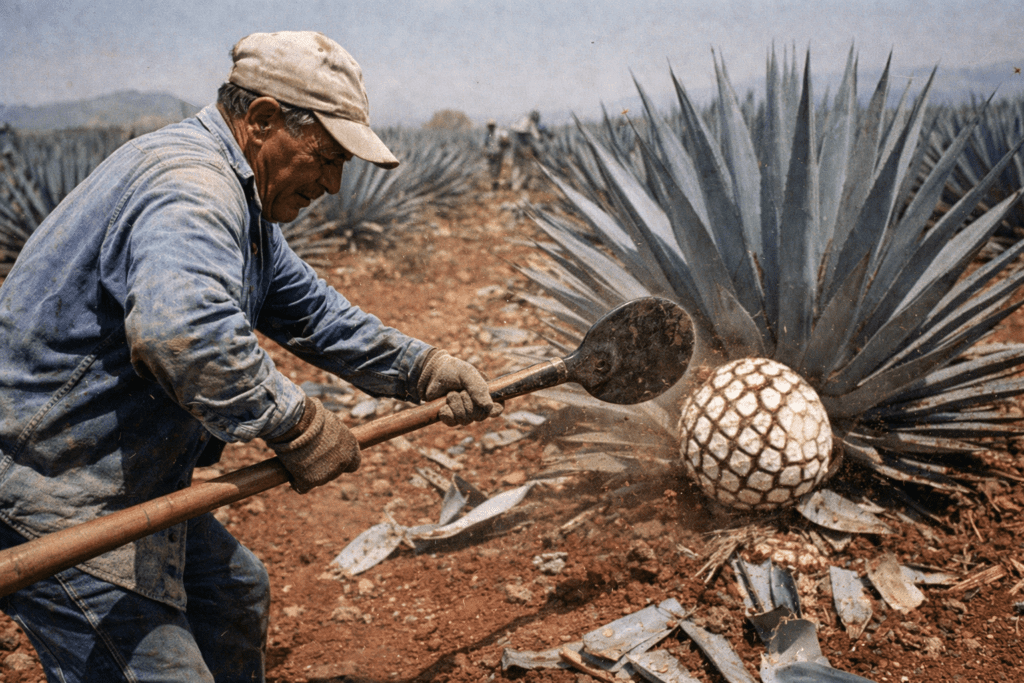
The primary tool is the coa—a flat, round blade attached to a long wooden handle. It looks simple. But in the hands of an experienced jimador, it’s precise and efficient.
The coa serves multiple purposes. It cuts away the thick outer leaves (pencas) to expose the piña. It trims the roots at the base. It shapes the piña into a clean, transportable form. All of this happens in the field, under the sun, with speed and accuracy.
Watching a jimador work is impressive. They move quickly but deliberately. Each strike of the coa is calculated. They waste no motion. A skilled jimador can harvest 100-150 plants per day.
Harvesting agave isn’t just about cutting. It’s about timing.
If you harvest too early—say, at four or five years—the piña is small and low in sugar. The plant hasn’t reached its full potential. You’re throwing away quality for speed.
If you harvest too late—beyond ten years—the plant may have already sent up a quiote and diverted sugars into reproduction. Or it may have contracted disease. Over-mature agave can develop fibrous texture and off-flavors.
The optimal harvest window is narrow. Seven to eight years for most blue weber agave. Maybe nine or ten in cooler, high-elevation Highlands areas.
Jimadores watch for specific signals:
- Leaf color shifts from blue-gray to slightly yellow
- The plant stops producing new leaves
- The rosette begins to tighten at the center
- A quiote starts forming (this triggers immediate harvest)
These signals tell the jimador: the plant is ready.
Once the jimador identifies a ready plant, the harvest process begins.
Step 1: The jimador positions the coa and strikes the base of the outermost leaves. Each swing removes a penca cleanly. They work in a circular pattern around the plant, moving inward.
Step 2: The thick, spiny leaves fall away. The piña begins to emerge. It looks like a giant pineapple—dense, pale, and fibrous.
Step 3: Once all leaves are removed, the jimador cuts the roots at the base. The piña is now free from the ground.
Step 4: The jimador trims any remaining leaf stubs and shapes the piña. The goal is to maximize usable material while removing fibrous waste.
The final piña weighs 80-150+ pounds, depending on maturity and growing conditions. It’s heavy, awkward, and difficult to move. But jimadores manage them with practiced ease.
After harvest, the piñas are loaded onto trucks and transported to the distillery. Time matters. The sugars inside the piña begin breaking down as soon as it’s cut. Most producers cook their agave within 24-48 hours of harvest.
Here’s something most people don’t realize: the weight of a piña doesn’t automatically mean quality.
A bloated, over-irrigated four-year-old plant might weigh 80 pounds. But it’s full of water and low in sugar.
A properly-grown seven-year-old plant might also weigh 80 pounds. But it’s dense with concentrated sugars and aromatic compounds.
Experienced jimadores can feel the difference. They know when a piña has substance versus when it’s just mass. That knowledge matters.
Respecting blue weber agave means respecting the jimadores who harvest it. These are skilled craftspeople working in harsh conditions. They understand the plant better than most distillers.
When you drink quality tequila, you’re tasting their expertise. They chose the right plant at the right time. They harvested it carefully. They preserved the integrity of the raw material.
That craft deserves recognition.
Next, let’s talk about what happens after harvest. Because understanding propagation and post-harvest processing completes the picture.
From Field to Fermentation: What Happens Next
Understanding agave propagation and what happens after harvest reveals why blue weber agave is both abundant and vulnerable.
Most blue weber agave doesn’t grow from seed. It grows from clones.
Agave plants produce hijuelos—small offshoots or “pups” that grow at the base of the parent plant. Farmers dig up these hijuelos and transplant them into fields. The new plant is genetically identical to the parent.
This is called vegetative reproduction. It’s fast, reliable, and how the industry has operated for decades. Most of the blue weber agave growing in Jalisco today came from clones.
But there’s a problem: genetic uniformity creates vulnerability.
When every plant in a field is genetically identical, they all share the same weaknesses. If a disease or pest evolves to attack that specific genetic profile, it can wipe out entire fields.
This isn’t theoretical. It’s already happened.
In the 1990s and 2000s, agave fields across Jalisco faced outbreaks of plagas—pests and diseases that spread rapidly through cloned monocultures. Producers lost millions of plants.
The lack of genetic diversity makes blue weber agave fragile. And most producers continue cloning because it’s cheaper and faster than growing from seed.
Some forward-thinking producers are experimenting with seed propagation. This creates genetic diversity and strengthens the plant population. But it’s rare. The industry still relies heavily on cloning.
This vulnerability is something consumers should understand. The plant that defines tequila is at risk because of how it’s farmed.
Once a piña is harvested, the clock starts ticking.
The sugars inside begin breaking down. Enzymes activate. Oxidation begins. If the piña sits too long before processing, sugar content drops and off-flavors develop.
Most craft producers cook their agave within 24-48 hours of harvest. Industrial producers may let piñas sit longer because they’re processing high volumes. But that delay affects quality.
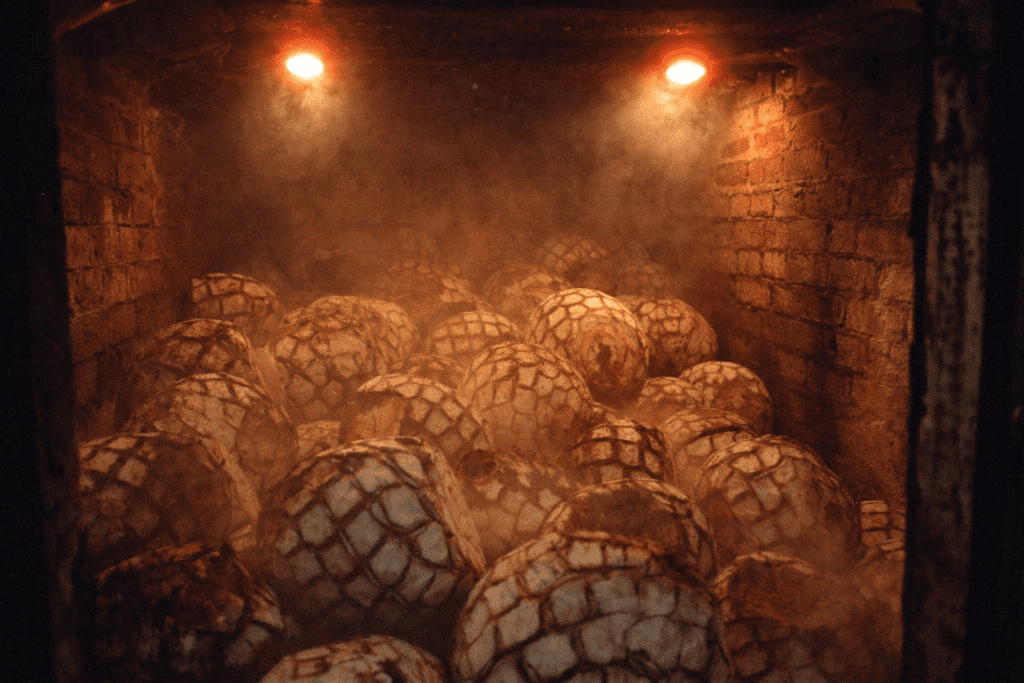
At the distillery, the piñas undergo one of three cooking methods:
Stone or brick ovens (traditional): The piñas are stacked in large underground or above-ground stone ovens. They’re cooked slowly over 24-72 hours using steam or low heat. This gentle process converts inulins to fructose while keeping aromatic compounds. It’s slow, expensive, and produces the highest quality.
Autoclaves (modern but acceptable): These are steam ovens that cook agave faster than traditional brick ovens. But low-pressure vs high-pressure makes a big quality difference. Low-pressure autoclaves cook more gently and usually longer, allowing starches to convert into sugars more evenly and preserving more natural agave flavor and complexity. High-pressure autoclaves cook much faster, which boosts efficiency but can flatten flavor and create harsher, “rushed” notes if anything is even slightly off. The truth is, many producers can make excellent tequila with low-pressure autoclaves. But it’s far more difficult to produce truly high-quality tequila using high pressure, because the margin for error is much smaller and the process demands extreme precision from start to finish.
Diffusers (industrial shortcut): This is the method to avoid. Diffusers shred raw, uncooked agave and use hot water and acids to chemically extract sugars. It’s fast and cheap. But it strips away all the aromatic compounds that traditional cooking develops. The result is neutral, flavorless alcohol.
Cooking method matters as much as agave maturity. You can start with perfect seven-year-old blue weber agave and ruin it with a diffuser.
After cooking, the agave is crushed to extract the juice (aguamiel). That juice ferments with yeast, converting sugars into alcohol. Then it’s distilled twice to produce tequila.
From here, the tequila may be aged in barrels or bottled as blanco. Either way, the foundation was set in the field.
If the agave was mature, properly grown, and traditionally processed, the tequila will have depth and character. If shortcuts were taken at any stage, no amount of aging will fix it.
That’s why understanding blue weber agave—from propagation to processing—gives you the tools to identify quality.
Now let’s address the myths. Because there’s a lot of misinformation about blue weber agave that needs correcting.
Common Misconceptions About Blue Weber Agave
Let’s clear up the myths.
Myth 1: “Agave Grows Fast, Like Corn or Sugarcane”
False. Blue weber agave takes seven to ten years to reach harvestable maturity. It’s one of the slowest-growing crops used for alcohol production.
Corn grows in months. Sugarcane in a year. Barley for whiskey? One season. Agave? A decade.
This timeline is biological, not negotiable. Anyone telling you agave grows fast is either lying or doesn’t understand the plant.
Myth 2: “All Agave Tastes the Same”
False. Terroir matters enormously.
Highlands agave grown in iron-rich volcanic soil produces sweeter, more floral tequila. Lowlands agave from clay soil produces earthy, mineral, herbal profiles.
Even within regions, micro-climates affect flavor. A hillside with more sun exposure produces different character than a shaded valley.
Agave is no different than wine grapes. Where it grows shapes what it tastes like.
Myth 3: “Bigger Piñas Mean Better Tequila”
False. Weight doesn’t equal quality.
A 100-pound piña from a four-year-old plant that was over-irrigated is full of water and low in sugar. A 90-pound piña from an eight-year-old plant grown naturally is dense with concentrated sugars and aromatics.
Experienced jimadores know this. They can feel the difference. Mass-market producers don’t care. They chase volume, not quality.
Myth 4: “Blue Weber is Just a Marketing Term”
False. It’s a legal and botanical designation.
Agave tequilana Weber var. azul is the only agave species legally allowed for tequila production under Mexican denomination of origin law. This is enforced by the CRT.
If a spirit uses a different agave species, it’s mezcal, sotol, raicilla, or bacanora—not tequila.
“Blue Weber” isn’t marketing. It’s regulatory compliance.
Myth 5: “Agave is a Cactus”
False. Agave is a succulent, not a cactus.
It belongs to the Asparagaceae family. Botanically, it’s closer to asparagus, yucca, and aloe than to cacti.
The confusion happens because agave grows in desert climates and has thick, spiny leaves. But the plant structure, reproduction method, and cellular biology are completely different from cacti.
This might seem like a minor point. But it reflects how little most people—including industry professionals—actually know about the plant.
Understanding blue weber agave means separating fact from myth. Once you know what’s true, you can identify quality.
How to Identify Quality Blue Weber Tequila
Now that you understand the plant, here’s how to identify quality tequila based on blue weber agave.
Step 1: Check the Label for “100% Agave” or “100% Agave Azul”
This is non-negotiable. If the label doesn’t explicitly say “100% Agave,” you’re drinking mixto—a blend of agave and non-agave sugars.
Mixto is legal. It’s cheaper. But it’s not quality.
Legitimate producers proudly display “100% Agave Azul” or “100% Blue Weber Agave” on the front label. If you have to search for it, that’s a red flag.
Step 2: Research the NOM Number
Every tequila bottle must display a NOM number—a four-digit code identifying the distillery. Look it up on Tequila Matchmaker.
You’ll discover:
- How many brands share that distillery
- What production methods they use
- Whether they’re committed to additive-free production
If a “premium” brand shares a facility with 30 other brands and uses diffuser processing, you’re paying for marketing, not quality.
Learn more about NOM numbers and supply chain transparency.
Step 3: Look for Additive-Free Verification
Mexican law allows up to 1% additives without disclosure. Most aged tequilas contain glycerin, caramel coloring, or oak extract.
Tequila Matchmaker previously maintained an additive-free certification list that referenced a third-party audit process. However, due to legal complications and ongoing litigation, they have since removed those specific certification and audit-related claims from their platform.
Today, Tequila Matchmaker features a Brand Alliance partnership program on the website, reflecting the current structure for producer participation and transparency.
Additive-free tequila tastes like agave. Additive-heavy tequila tastes like artificial sweetness and fake vanilla.
Step 4: Ask About Agave Maturity
If you’re buying from a distillery, distributor, or knowledgeable retailer, ask: “How mature is the agave?”
Craft producers will tell you: “We harvest at seven to eight years.” They’ll share average sugar content (TSS). They’ll talk about their agave sourcing.
Industrial producers dodge the question. They talk about barrels, awards, or celebrity endorsements instead.
If a brand can’t or won’t tell you about their agave, that’s a red flag.
Step 5: Taste for Agave Character
Quality blue weber agave tequila should taste like agave.
In blanco, you should taste cooked agave sweetness, mineral notes, and either floral (Highlands) or earthy (Lowlands) character.
In reposado or añejo, oak should enhance—not bury—the agave. You should still taste the plant underneath the wood.
If all you taste is vanilla, caramel, and oak with zero agave character, you’re drinking oak-flavored vodka. That’s not craft. That’s shortcuts.
Red Flags to Avoid:
- No “100% Agave” designation
- Celebrity-backed brands with vague production details
- Tequila that costs $200+ but shares a high-volume contract distillery
- Brands that won’t share agave maturity or sourcing
- Tequila that tastes like artificial sweetness or fake vanilla
Quality blue weber agave tequila exists. But you have to know what to look for. Now you do.
The Bottom Line: Blue Weber Agave is Where Quality Starts
Great tequila starts in the field, not the barrel.
Blue weber agave is the foundation of everything. The seven-to-ten-year maturation timeline. The terroir absorption that shapes flavor. The sugar density that creates aromatic complexity. The jimador’s craft that preserves integrity.
Everything downstream—cooking, fermentation, distillation, aging—depends on starting with mature, properly-grown blue weber agave.
If the plant wasn’t right, no barrel will save it. No celebrity endorsement will make it quality. No marketing budget will create craft where there was none.
Understanding blue weber agave gives you the tools to separate craft from shortcuts. You can research NOM numbers. You can ask about agave maturity. You can taste for agave character instead of oak and additives.
You can respect the plant and the Mexican families who’ve cultivated it for generations.
Because that’s what this is really about: respect.
Respect for the jimadores who work in harsh conditions. Respect for the producers who wait seven years instead of rushing harvest. Respect for the craft that creates tequila worth drinking.
When you understand blue weber agave, you understand tequila. And you’ll never settle for mediocrity again.
Want to go deeper? The DOC Agave Masterclass Certification teaches you how to evaluate tequila from field to glass. You’ll learn production methods, additive identification, and how to use tools like Tequila Matchmaker.
Because understanding the plant is just the beginning. Real expertise comes from knowing how to apply that knowledge.
— Doc Agave