
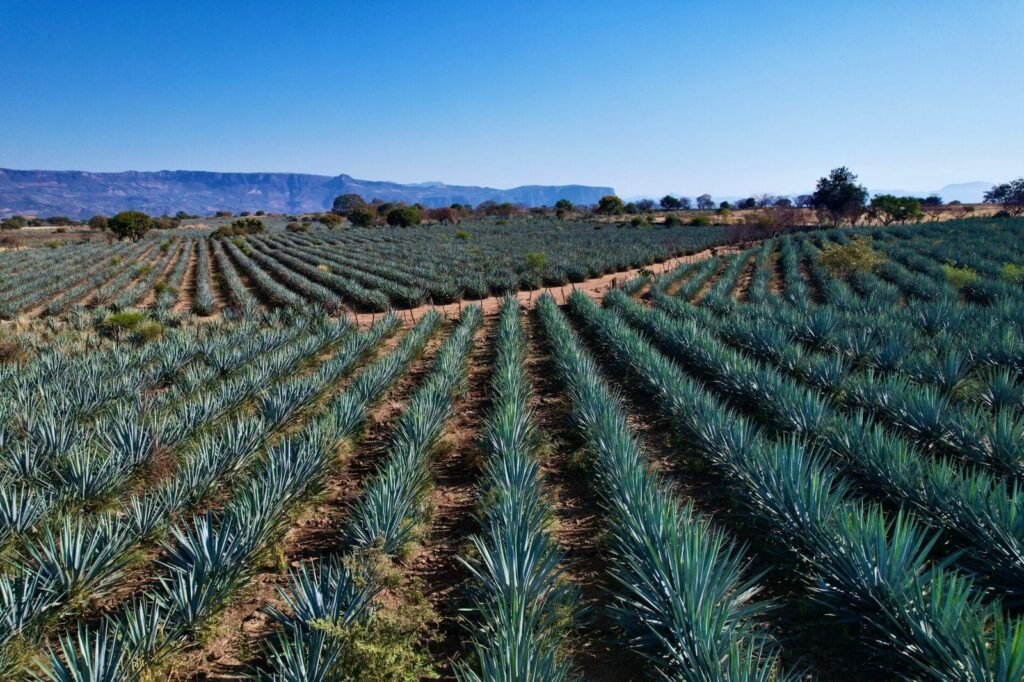
Tequila’s environmental impact begins long before a bottle leaves a distillery. It starts with blue Weber agave farming, then continues through cooking, fermentation, distillation, wastewater treatment and packaging. Each stage uses resources or leaves byproducts that have to be managed. The better question is what happens on the farm and inside the distillery, not whether a producer calls its tequila sustainable.
Agave sustainability is also more complicated than choosing between old and new equipment. A traditional method may use fewer chemicals in one step yet require more time or energy in another. A modern plant may be more efficient but still manage its wastewater poorly. Looking at the full process helps us distinguish documented improvements from attractive marketing.
Key Takeaway: Tequila production has environmental costs in cultivation, water use, energy and waste. Blue Weber agave farming can affect crop diversity and pollinator habitat, while distilleries must manage liquid vinasse and solid bagasse. Sustainable practices are possible, but they require evidence about actual farming and treatment methods, not just an artisanal label or a company's promise.
What is the environmental impact of tequila production?
The environmental impact of tequila production begins in blue Weber agave fields, where land management can affect biodiversity. Distilleries also use water and energy, and they create wastewater and fibrous waste. The effects depend on farming conditions, distillery operations and waste treatment.
A useful way to understand the process is to follow the agave from field to finished product rather than judging the brand by its bottle. The University of Waterloo’s overview of industrial tequila’s environmental impacts identifies several of these pressures and places them in a wider discussion of production and livelihoods.
| Stage | Main environmental question | Evidence worth checking |
|---|---|---|
| Agave cultivation | How does growing one crop affect land and biological diversity? | Planting practices, land history, soil care and flowering habitat |
| Cooking and distilling | How much water and energy does the actual process use? | Metered water, fuel source, process efficiency and stated measurement boundary |
| Waste handling | Where do liquid vinasse and solid bagasse go? | Treatment records, byproduct destinations and discharge controls |
| Packaging and distribution | What resources are used after distillation? | Glass weight, recycled content, shipping and life-cycle assumptions |
This map is a way to ask better questions, not a formula for assigning every tequila a carbon score. A claim about one efficient piece of equipment tells us little about the rest of the operation.
Blue Weber agave farming and genetic diversity
Tequila producers use the blue variety of Agave tequilana, usually called blue Weber agave. The plants take several years to reach harvest, so decisions made in the field have long consequences for growers. DOC Agave’s blue Weber agave guide explains why the plant’s biology and cultivation are central to understanding tequila.
Commercial farms commonly propagate blue agave using offshoots, or hijuelos, rather than seeds. This gives growers predictable crops, but relying heavily on closely related planting material raises concerns about genetic diversity. Genetic similarity may limit the range of traits available to respond to changing pests, disease or growing conditions.
A 2026 genomic study of tequila agave and its relatives found that modern cultivated tequila agave is highly genetically similar, although not completely identical. The researchers also identified greater diversity in older landraces. That is an important distinction. It supports efforts to conserve remaining agave relatives and agricultural knowledge, but it does not mean every present-day farm has the same level of pest damage.
Land management matters alongside plant genetics. Agave monoculture can change the landscape when growers replace varied vegetation with one crop. Soil care, planted boundaries and farming practices also shape conditions around the fields. A responsible environmental assessment should look at the land’s previous use and current management, not simply count how many hectares of agave a producer owns.
What do flowering agave and bats have to do with tequila?
Agave flowers provide food for pollinators, including nectar-feeding bats. Yet growers often harvest tequila agave before it flowers because the mature heart stores carbohydrates needed for production. Farmers generally propagate new plants from offshoots. Wild agave reproduction and commercial tequila farming therefore follow different patterns.
The issue is not that every harvested tequila plant has failed to feed a bat. It is that large areas managed without flowering plants can offer fewer floral resources than a more diverse landscape. Conservation efforts can consider flowering corridors, habitat protection and how to preserve genetic diversity while maintaining a viable agricultural crop.
A blanket statement that allowing a few plants to flower makes an entire tequila operation sustainable would be misleading. The relevant evidence includes habitat context, actual land practices and whether the species being discussed is blue Weber agave or another agave grown for a different spirit.
Where does tequila production use water?
Tequila production uses water at several stages. Rainfall, soil and irrigation shape water needs on farms, while distilleries use water for processing and cleaning. Steam cooking, cooling, fermentation operations and equipment washing all have different demands. One water-use figure can hide these differences unless the source states which steps it measures.
Local conditions are essential to interpreting tequila water usage. Water withdrawal in a region facing seasonal scarcity has different consequences from the same withdrawal under a different supply and management system. The right questions include where the water comes from, whether usage is measured, and what happens to it once the production process is finished.
Wastewater deserves its own attention. Distillery wastewater may contain organic residues. Treatment needs depend on the process stream and the rules for reuse or discharge. Simply using less fresh water is not sufficient if the remaining wastewater is handled poorly.
Vinasse and bagasse, tequila’s two major waste streams
Two terms help explain tequila waste. Bagasse is the fibrous plant material left after agave juice has been extracted. Vinasse is a liquid residue associated with the distillation process. They are different materials and require different management approaches.
Distilleries can compost bagasse or process it into other materials or fuel. Those uses can reduce waste, but benefits depend on how facilities handle the material and what happens to the finished product. A circular-economy proposal is not proof that all of a distillery’s bagasse is being responsibly recovered.
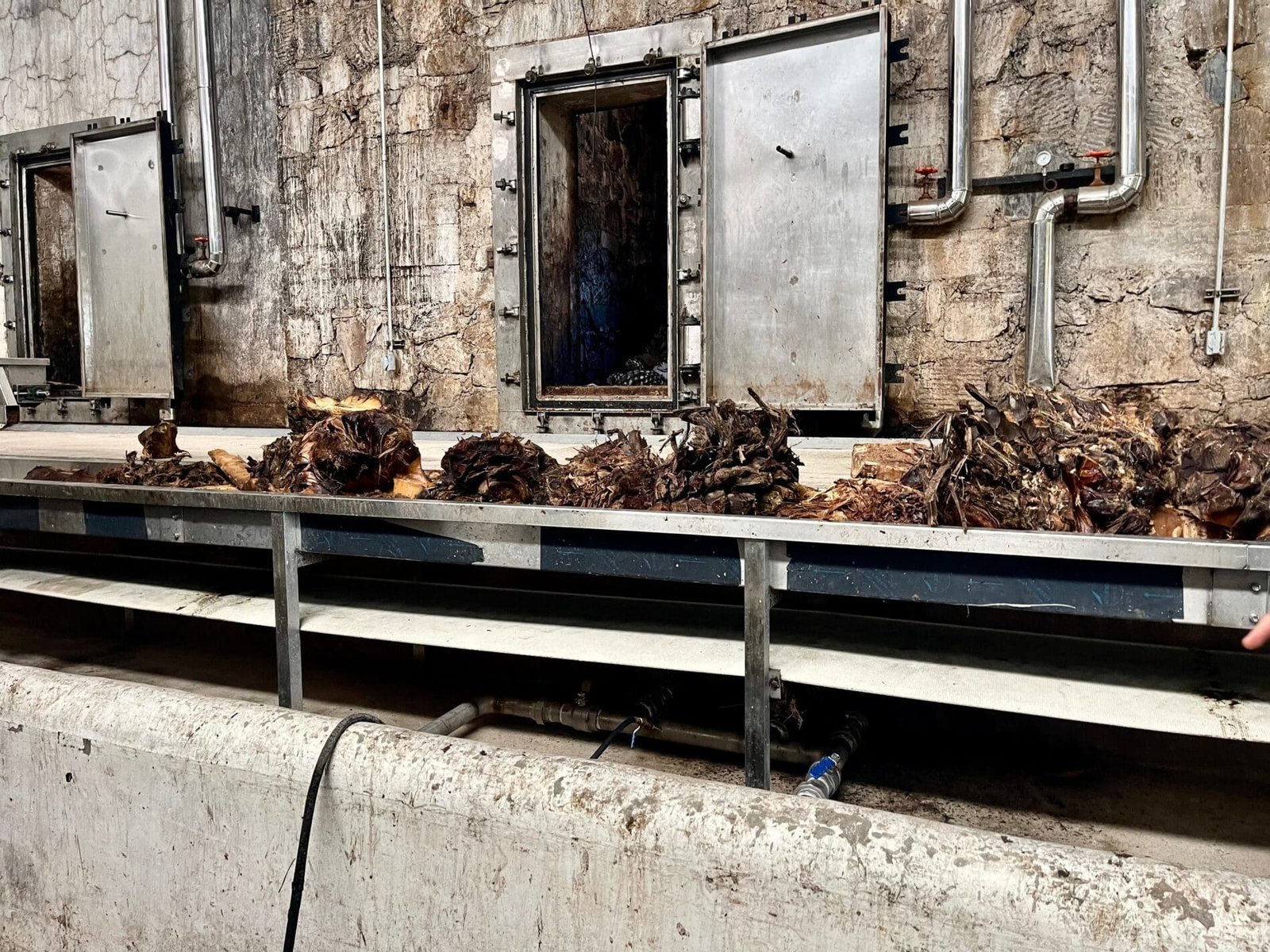
The Jalisco photograph above shows fibrous agave material at a processing facility. It shows what bagasse can look like, not where the material went or whether anyone recycled it.
Vinasse poses a different challenge. Its organic content can harm soil or water when facilities dispose of it without proper treatment. An open-access research review on vinasse as a soil amendment describes the importance of understanding the material and management conditions before treating it as a resource. Treatment may involve biological processes, controlled reuse or other methods appropriate to the facility.
The practical test is not whether a distillery says it has “zero waste.” It is whether it can explain its waste streams, show meaningful treatment or recovery records and account for the residual material after processing.
Cooking, distilling, energy and packaging
After harvest, agave hearts, or piñas, are processed to make fermentable sugars available. Heating and extraction methods influence the steps required before fermentation. Research indexed by FAO AGRIS on cooking blue Weber agave describes how heat and moisture break down complex agave fructans during traditional cooking. It explains food chemistry, not the environmental superiority of one oven.
A brick horno, a pressurized autoclave and an extraction system such as a diffuser do different jobs under different operating conditions. DOC Agave’s comparison of diffuser and traditional tequila production discusses these processing distinctions. But the environmental question also requires data on heat, fuel, water, cleaning, treatment and production volume. A slower process is not automatically lower in emissions, and a faster machine is not automatically greener.
Distillation itself requires thermal energy. Fuel source, heat recovery, operating efficiency and the power used across the facility all influence what should be counted. Later stages matter too. Glass production, packaging choices and transportation may be relevant when assessing a finished bottle rather than only the spirit leaving the still.
Environmental comparisons work best when they measure the same stages. It makes little sense to compare one oven’s energy use with another producer’s total footprint.
Is tequila production sustainable?
Tequila production can become more sustainable through better land stewardship, water management, energy efficiency and responsible treatment of vinasse and bagasse. For any producer, measurable practices and local conditions matter more than its equipment label or marketing. Look for results that independent reviewers can check.
The Tequila Regulatory Council’s sustainability program describes industry goals and areas of work including energy, water, waste and agricultural practices. These initiatives show the industry’s stated priorities. Goals, company participation and stated commitments, however, are not the same as independently confirmed environmental performance for every distillery.
The word sustainable also covers more than the production line. Farming choices may affect nearby ecosystems, while market conditions influence growers’ ability to invest in soil care or longer-term improvements. A credible explanation should acknowledge these trade-offs without treating every problem as equally severe at every site.
How to evaluate tequila sustainability claims
When a producer discusses tequila sustainability, asking for evidence is more useful than seeking one appealing label. A company may have real improvements in some areas while still facing unresolved challenges in others.
A practical set of questions can help readers interpret what is being claimed.
- Land and crops. What is known about prior land use, field management, soil protection and agave planting diversity?
- Water and waste. Does the producer report meaningful water-use boundaries and explain where vinasse and bagasse go?
- Energy and emissions. Are claims based on measured operations, and do they identify which production stages and fuels are included?
- Verification. Is the claim backed by a credible dated report, an appropriate external review, or only the company’s own marketing material?
A claim needs evidence that readers can check. A broad commitment to protect nature does not establish that a site has reduced emissions or prevented deforestation. Likewise, a single recycling project does not account for all production byproducts.
Transparency also matters when a brand talks about authenticity. DOC Agave’s guide to real tequila explores why legal identity and production transparency are different questions. Environmental performance adds another distinct layer that deserves its own evidence.
Growers, livelihoods and the agave supply cycle
Blue Weber agave grows on a multi-year cycle, so growers cannot adjust production as quickly as someone might change a factory order. Changes in demand and agave prices can affect planting decisions, contracts and the ability of smaller farms to invest for the long term. These economic realities sit beside the ecological challenges.
Marcus Guiliano’s original DOC Agave Masterclass sustainability lesson raises concerns about agave supply and the position of smaller producers. Those observations offer a human perspective on the industry. They do not independently establish what any producer pays growers or how it manages its environmental impact.
Sustainable agriculture has to remain workable for the people growing the crop. That makes questions about reliable purchasing relationships and the costs of better land stewardship relevant. It does not justify assuming a large company is necessarily irresponsible or a small producer is automatically environmentally exemplary.
A better way to discuss tequila’s environmental future
Tequila environmental impact is best understood as a chain of decisions rather than a contest between romantic tradition and industrial efficiency. What was grown, how it was processed, what resources were used and how wastes were treated all matter. The strongest sustainability claims acknowledge their boundaries and provide evidence that readers can evaluate.
For a broader foundation on tequila’s plants, production and people, explore DOC Agave’s tequila masterclass. The goal is to understand the process well enough to ask more informed questions, not to accept every claim printed on a label.